Leyla Gencer, as a female figure
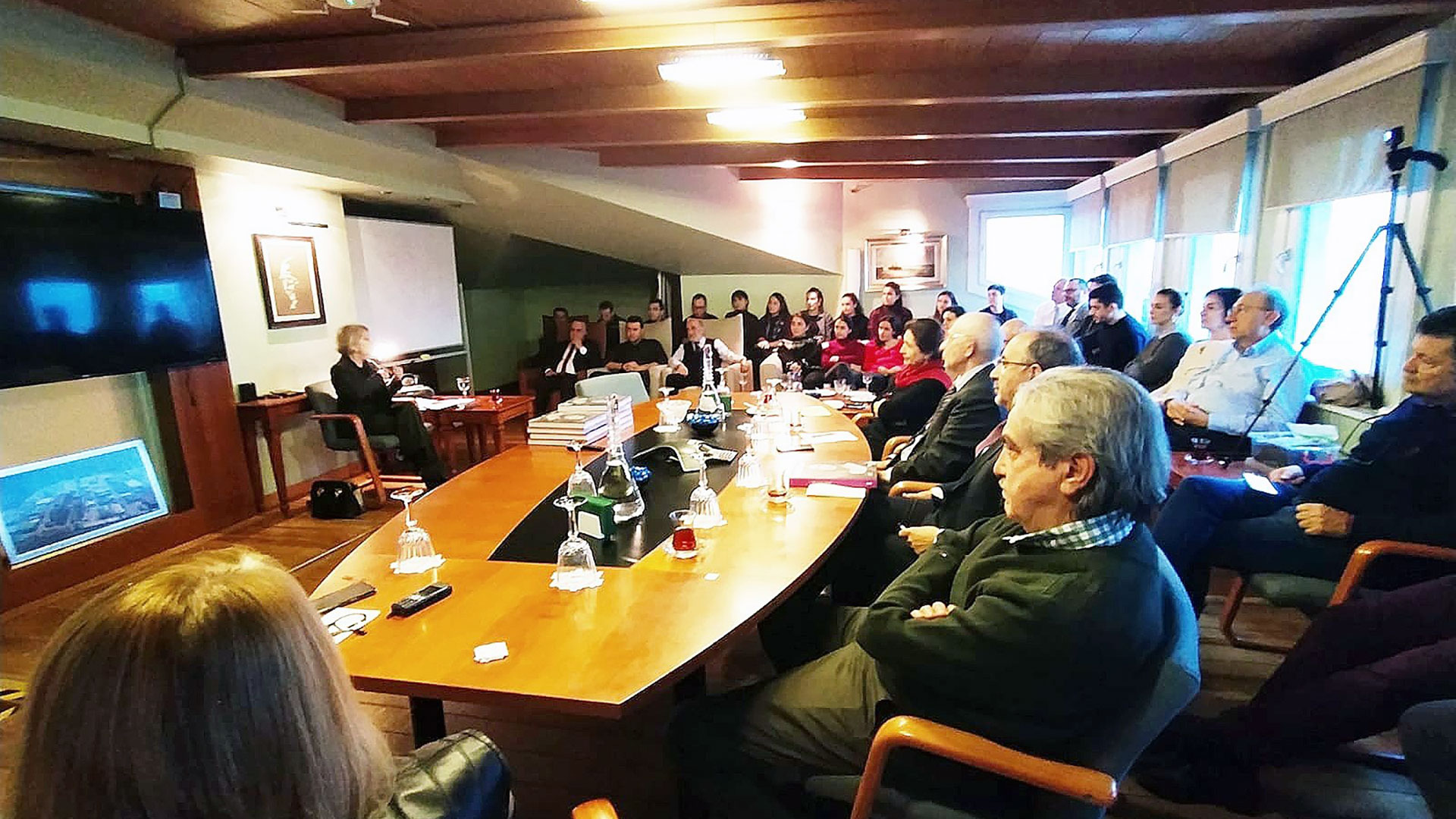
Music critic, writer and researcher Evin İlyasoğlu participated as speaker at our January Roftoop Seminars. Evin İlyasoğlu mentioned about the life of worldwide known opera singer Leyla Gencer who is called La Diva Turca and who made an impression on opera community.
Leyla Gencer was a strong woman.
A woman who set out on her own and went to Italy, who performed in countless opera productions without an impresario, who projected the image of a woman not dependent on a man—on her husband.
Speaking in the first person, as Leyla Gencer herself, she summarizes her life on her deathbed as follows:
“For 33 years, I performed seventy-three different prima donna roles on sixty opera stages. These were mostly dominant female roles; sometimes, however, women who were wronged, powerless, or victimized.”
Her psychological collapse during illness is reflected clearly. Melahat, a close friend almost like a relative, is someone she does not want to see her on her deathbed either:
“I cannot bear the idea of them seeing me weak, neglected, without makeup, as I am leaving life,” she says.
Her closest friend Franca visits her and says,
“You are the woman who played those powerful queens—how is this possible? Are you afraid of death now?”
Leyla responds, “This is something else.”
(This has nothing to do with being a powerful woman like Lady Macbeth.)
Her other close friends have always known her as a proud, strong woman.
“They find it hard to believe this state of mine. But even Lady Macbeth could not know what the next few minutes would bring.”
Her obsession with aging and age is also addressed. You could talk to her about anything—but NEVER about AGE. This is a trait shared by many women, especially opera singers.
Perhaps she concealed her age so as not to invite comments such as, “At her age, she cannot perform this role anymore,” because she began her career later than other stars. Her official birth record states “10 Teşrin-i Evvel 1335” (October 10, 1919). Yet over the years she shifted it forward, first to 1923, then 1924, 1926, and finally 1928.
On FEMININITY—her governess, a French mademoiselle, a French countess, taught her French and Italian as a child, read poetry to her, and sang children’s songs. In the large house where she grew up, this governess was the one who cared for her most—adorning her, making her dance, sing, and raising her as a young lady. This became a formative and positive foundation in her life.
HER FIRST LOVE, HILINSKI—She is sixteen years old; her father has just passed away.
Leyla is now a young woman whose emotions have fully awakened.
She attempts to marry a Polish teacher who visits the house and is twenty years older than her, but this marriage is opposed.
Because she cannot marry her first love and due to the loss of her father, a deep sense of SEEKING SHELTER emerges.
She meets İbrahim Bey, a bank clerk, and enters into a quick marriage. For her, marriage is essentially leaning on a man.
Even if she did not consciously choose it, this situation suits her well and, in the long run, has a positive effect on her career. İbo is very supportive of Leyla Gencer as she sets sail toward world-class success.
MUHIDDIN SADAK notices Leyla Gencer in the choir and becomes instrumental in bringing her to the forefront. This is a major turning point in her life.
ARRIGO LOMBARDI is another crucial influence. Both in opera and through her elegance, impeccable grooming, and polished appearance, Lombardi deeply impresses Leyla Gencer and becomes a role model as a woman.
IN ANKARA, Leyla Gencer is a woman who enters the kitchen, a gracious hostess.
She entertains high-ranking state officials in her home, finds topics of conversation, is talkative, forms friendships with foreigners, and stands out for her femininity. She has her clothes tailor-made—very chic, modern, yet distinctly feminine.
“I had the courage of youth. I had built an elite circle. At those receptions, I spoke passionately and enthusiastically on every subject. I had general knowledge, European culture, and Eastern culture.
Dressing well, owning jewelry, paying attention to makeup—these were all factors that attracted attention in this milieu,” she summarizes her Ankara years.
The American Ambassador McGhee never misses any of her performances and sends her armfuls of flowers. About this, Gencer says:
“There was a pleasant closeness between us; warm and dreamy breezes were blowing.”
She goes to ITALY through a cultural exchange program. She receives an invitation to sing for the first time in a large arena—the Flegrea Arena in Naples.
After rehearsals, every evening she goes to a café in the city and sits at the same table. She does not have many clothes, but she adorns what she wears with a brooch, a necklace, or a scarf. One day she wears her hair in a bun, another day curled.
Who is this woman with such an upright posture, sitting at the same table every day?
Over time, she begins to know her audience. She walks through the city streets, talks with people.
Now she is ready to step onto their stage as a prima donna.
Her closeness to the people also fills the ordinary citizens with pride. For she is still a chic woman in the streets—wrapped in her fur, with silk scarves and the jewelry she never removes.
PERFECTION IN EVERYTHING
She is extremely meticulous not only in her dress and stage roles, but also in the tables she sets at home and the meals she prepares. She is very nervous until the moment she steps onto the stage, but once she embodies the role, she becomes part of the work itself.
The roles she plays are queens (elegant, ornate women) or women who are victims of fate (yet still beautiful women).
ORCHESTRA CONDUCTORS
In Italy, the first conductor to discover her is Serafin, who also admires Leyla, as does Maria Callas. She works with many opera stars of great renown.
Her relationship with one of the most famous conductors of the time, Gavazzeni, lasts for many years, and Leyla learns a great deal from him.
Especially during the time they spend together in Venice, he takes her to galleries, museums, and exhibitions; Leyla gains much from these educational excursions. She also learns not to be one-dimensional.
An opera singer must be versed in every art form—literature, painting, sculpture, architecture, dance, as much as music.
Another conductor she greatly admires is Gui.
All of these are masters who instill in Leyla a deep sense of aesthetics.
Despite maintaining close relationships with all these conductors, she never neglects her husband İbo until the end of her life—a devoted wife.
In her correspondence with Serafin, the lines between the words reveal their mutual admiration. (This is a period without telephones or computers.)
IDENTIFICATION WITH THE CHARACTER
Identifying with the character she plays is the most important skill of a theater artist—especially for an opera singer. One must exist simultaneously within the music, the poetry (libretto), and the dance.
Leyla is on stage with her entire being, displaying her power as a woman.
She is confident in herself and in her femininity—so much so that after performances, she leaves without removing her makeup to attend the parties immediately. For example, she attends a party after Aida with the dark complexion of the Ethiopian princess still on her face.
THE BEL CANTO ERA
“Bel canto” means beautiful singing; it is not about shouting. During Leyla’s years in Italy, beginning in the 1950s, this style of singing comes back into prominence. Until then, sopranos had accelerated tempos and raised their voices, creating a style that moved away from the essential characteristic of composers like Verdi and Puccini—beautiful singing.
Singing softly is a feminine approach. Yet Leyla uses such technique that even the listener at the very back of the hall hears her clearly—imbued with all her feminine grace.
After her active years as a prima donna, Evin İlyasoğlu recounts Gencer’s song recitals, her teaching in Italy and Turkey, and the Leyla Gencer International Competition.
She concludes her talk with an imagined dialogue between Gencer and a young virtual interlocutor, spoken by someone who was present when her ashes were scattered in the Bosphorus as she bid farewell to life.